10 Fun Games That Quietly Boost Your Toddler’s Amazing Brain
Published: 6 Nov 2025
There’s a special kind of beautiful chaos that comes with having a toddler, isn’t there? One minute you’re marveling at them figuring out how to open a cabinet, and the next you’re fishing a soggy cracker out of the TV remote. It’s a whirlwind of new words, wobbly steps, and a personality that gets bigger every single day.
Amidst this whirlwind, it’s easy to feel a little pressure. You see ads for “educational” toys and apps, and a little voice might whisper, “Am I doing enough to help their brain grow?”
Let’s take a deep breath together and quiet that voice. Here’s the secret: you don’t need fancy flashcards or expensive subscriptions. The most powerful brain-building work your toddler can do happens through something you’re already an expert in: play.
We’re going to explore 10 simple, genuinely fun games that support your toddler’s cognitive development. Think of me as a fellow parent who has spent some time digging into the work of the experts so you don’t have to. We’ll look at what the giants of child development have to say and then turn their big ideas into easy, everyday activities.

First, What Exactly Is Toddler Cognitive Development?
Before we jump into the games, let’s quickly demystify this term. “Cognitive development” sounds so formal, but it’s really just the way your child’s brain develops the skills to think, learn, remember, and solve problems.
For a toddler, this looks like:
- Remembering where they left their favorite teddy bear (memory).
- Figuring out that a round block won’t fit in a square hole (problem-solving).
- Understanding that you still exist even when you hide behind your hands in peek-a-boo (object permanence).
- Pretending a banana is a telephone (symbolic thought).
These are all part of the big picture of how a child grows. Cognitive skills are just one piece of the puzzle, working right alongside their physical, social, and emotional growth.To see how this fits into the bigger picture, you might find our guide on What Are the 5 Main Areas of Child Development? really helpful.
The Secret Ingredient: Learning from the Giants of Play
I’m not a child psychologist, but I love learning from those who are. When you look into the research, two names pop up again and again: Jean Piaget and Lev Vygotsky. Their ideas are game-changers for understanding how our toddlers learn.
Piaget and the “Little Scientist”
Swiss psychologist Jean Piaget believed that children are like “little scientists.” They aren’t just passively absorbing information; they are actively experimenting on their world to understand how it works. When your toddler repeatedly drops a spoon from their highchair and looks at you, they aren’t just trying to test your patience (well, maybe a little). They’re conducting an experiment on gravity!
Vygotsky and “Helpful Scaffolding”
Russian psychologist Lev Vygotsky gave us the brilliant concept of “scaffolding.” Picture a builder using a scaffold to help them reach a higher part of a building. As parents, we do the same for our kids. We provide temporary support to help them achieve something they can’t quite do on their own yet. When you hold a puzzle piece in the right orientation for them to place it, that’s scaffolding. You’re not doing it for them; you’re giving them just enough help to succeed.
Keeping these two ideas in mind the “little scientist” and “helpful scaffolding” turns these games from simple pastimes into powerful interactions.
10 Simple Games to Boost Your Toddler’s Brainpower
Ready to play? Here are 10 games that use everyday items and put those expert theories into practice.
1. The “Where Did It Go?” Game (Object Permanence)
- What you’ll need: A small toy and a blanket or a few small cups.
- How to play: Show your toddler the toy. Make a big deal of it! Then, hide it under the blanket while they are watching. Ask, “Where did it go?” Encourage them to lift the blanket to find it. As they get better, you can use two or three upside-down cups and move them around after hiding the toy.
- What they’re learning: This is a classic for teaching object permanence, the foundational concept that things still exist even when you can’t see them. It’s a huge cognitive leap!
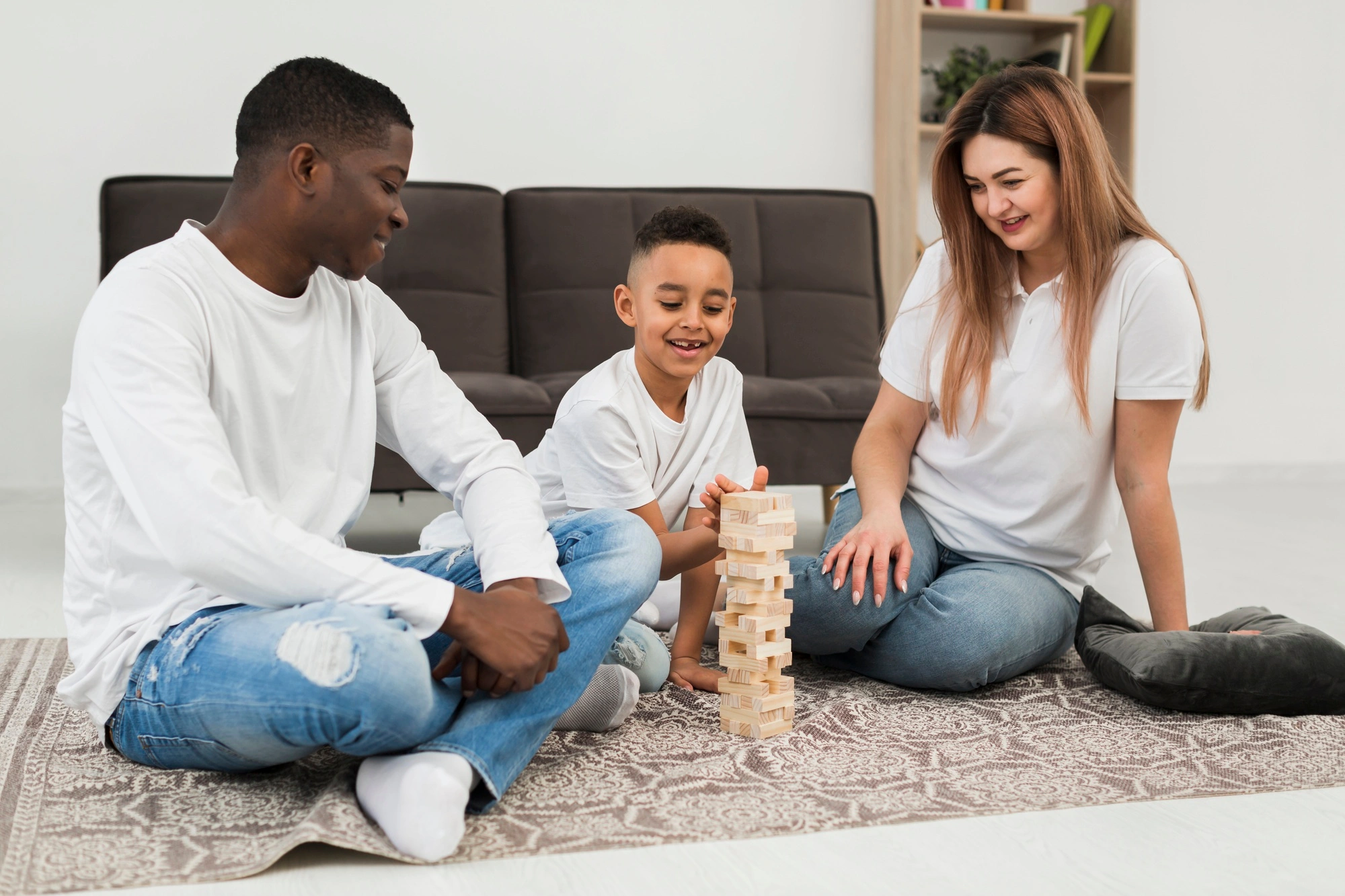
2. The Tower Tumble (Cause and Effect)
- What you’ll need: Soft blocks, stacking cups, or even empty (and clean!) yogurt containers.
- How to play: Sit on the floor and start stacking. You can build a tower together or take turns. The real fun, as every toddler knows, is in knocking it down. Cheer when it falls!
- What they’re learning: They are learning cause and effect (If I push this, it will fall), as well as basic physics, spatial awareness, and fine motor skills.
3. The Shape Sorter Challenge (Problem-Solving)
- What you’ll need: A simple shape-sorter toy or DIY one by cutting shapes out of a cardboard box lid.
- How to play: Hand your toddler a shape. Let them explore it. You can name the shape and its color. Guide their hand toward the sorter and let them try to find the right hole. Use scaffolding here: if they’re struggling, you can point to the correct hole or help them turn the block the right way.
- What they’re learning: This is a problem-solving powerhouse. It teaches shape recognition, spatial reasoning, and the persistence to try again.
4. The Great Sock Sort (Categorization)
- What you’ll need: A pile of clean laundry, specifically socks of different colors and sizes.
- How to play: Make a game out of laundry day. Dump the clean socks in a pile and say, “Let’s find the families!” Start by finding two matching socks and putting them together. Encourage your toddler to find other pairs. You can also sort by color (“Let’s find all the blue ones!”) or by size (“Where are the baby socks?”).
- What they’re learning: This introduces the concept of categorization, which is essential for logic and language. They learn to identify attributes like color and size and group similar items.
5. The Mystery Bag (Sensory Exploration)
- What you’ll need: A tote bag or pillowcase and a few familiar objects with different textures (a soft brush, a bumpy ball, a smooth block, a crinkly leaf).
- How to play: Let your toddler touch and see each object first. Then, place them all in the bag. Have them reach in without looking and guess what they are feeling. You can ask, “Is it soft? Is it bumpy?”
- What they’re learning: This game is fantastic for sensory processing and memory recall. It helps them build a mental image of an object based on touch alone.
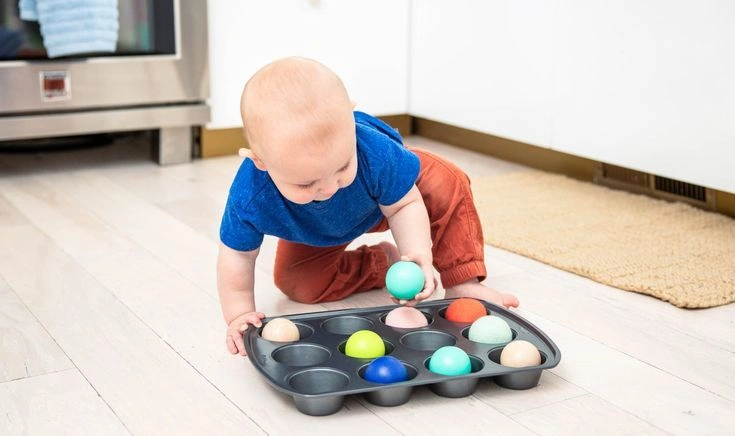
6. The Pretend Phone Call (Symbolic Thought)
- What you’ll need: A toy phone, a banana, or even just your hand.
- How to play: Hold a banana to your ear and say, “Hello? Oh, hi Grandma! Yes, the baby is right here.” Then offer the “phone” to your toddler. This can expand into having a tea party with stuffed animals or feeding a doll with an empty spoon.
- What they’re learning: This is the beginning of symbolic thought, the ability to make one thing stand for something else. This is the bedrock of all creativity, imagination, and even reading and writing later on.
7. Follow My Moves (Working Memory)
- What you’ll need: Just your bodies!
- How to play: Start with a simple action. Say, “I’m touching my nose!” and do it. Encourage your toddler to copy you. Then try another simple action, like clapping your hands or stomping your feet. As they get older, you can string two actions together: “First I clap, then I touch my toes!”
- What they’re learning: This game directly builds working memory (the ability to hold information in your head for a short time to complete a task) and attention skills.
8. The Blanket Fort Blueprint (Planning & Teamwork)
- What you’ll need: Blankets, pillows, and chairs.
- How to play: Announce, “Let’s build a house!” Drape a blanket over two chairs and invite your toddler to help. They can bring pillows inside or help you hold up a corner. The goal is the process, not a perfect structure.
- What they’re learning: Even on a simple level, this introduces planning, spatial reasoning (what fits where?), and teamwork. They are a “little scientist” figuring out how to create a stable structure.
9. “I Spy” with Colors (Observation & Language)
- What you’ll need: A room with a few colorful objects.
- How to play: Keep it very simple for toddlers. Say, “I spy something… blue!” and look pointedly at a very obvious blue object, like their blue ball. When they find it, celebrate! This is much more manageable for them than the abstract alphabet version.
- What they’re learning: This strengthens color recognition, observation skills, and the connection between words and objects.
10. The Pouring Station (Early Math Concepts)
- What you’ll need: A bathtub or a large plastic bin, a few plastic cups of different sizes, and water. (This is a great pre-bath activity).
- How to play: Simply let them pour. Let them fill a cup and dump it out. Let them pour water from a big cup into a small cup and watch it overflow.
- What they’re learning: They are conducting physics experiments! They’re learning about volume, capacity, and cause and effect in a hands-on, sensory-rich way.
It’s Not About Performance, It’s About Connection
Can we make a pact? Let’s agree that the goal of these games is not to create a “genius” baby or to check a developmental box. The true magic happens in the shared smiles, the silly moments, and the focused time you spend together.
If your toddler isn’t interested in a game, don’t force it. Try again another day or just follow their lead. Some days, the most valuable cognitive activity is cuddling on the couch and looking at a picture book. You are their safe space, and that feeling of security is the foundation on which all learning is built.

If you ever feel the pressure mounting, it might be a good time to read our thoughts on how to reduce parental burnout. Remember to be kind to yourself.
Common Questions About Toddler Cognitive Games
How long should we play these games?
For toddlers, think in short bursts. Five to ten minutes of focused play is fantastic. Their attention spans are short, and it’s better to have a joyful 5-minute game than a frustrating 20-minute one.
What if my toddler just wants to do it “wrong”?
This is their “little scientist” at work! If they want to put the puzzle pieces in their mouth or stack the socks on their head, let them. It’s their way of exploring the object’s properties. You can gently model the “right” way, but let them lead the experiment.
Are screen-based “educational games” just as good?
While some apps are better than others, the American Academy of Pediatrics emphasizes that hands-on, interactive play with a caregiver is far more valuable for a toddler’s developing brain than any screen. The 3D world of touch, texture, and human connection can’t be replicated on a tablet.
When should I worry about my child’s cognitive development?
All children develop at their own unique pace. There is a wide range of “normal.” However, if you have persistent concerns about your child’s progress or if they seem to be losing skills they once had, it’s always a good idea to chat with your pediatrician or a child development specialist.
For a general overview of what to expect, our guide to the 7 Stages of Child Development can provide a helpful frame of reference.
You are your child’s first and most important teacher. Not in a formal, high-pressure way, but in the way you sing songs, point out the dog on your walk, and get down on the floor to build a wobbly tower.
These games are just tools. The real work is in the love, the patience, and the joy you share every day. You’re already doing an amazing job. Now go have some fun.





- Be Respectful
- Stay Relevant
- Stay Positive
- True Feedback
- Encourage Discussion
- Avoid Spamming
- No Fake News
- Don't Copy-Paste
- No Personal Attacks
- Be Respectful
- Stay Relevant
- Stay Positive
- True Feedback
- Encourage Discussion
- Avoid Spamming
- No Fake News
- Don't Copy-Paste
- No Personal Attacks
