How to Teach Empathy: A Real-Life Guide for Raising Kind, Emotionally Intelligent Kids
Published: 7 Nov 2025
It happened at the park. My son, usually so sweet, snatched a bright red bucket from another toddler. The other child’s face crumpled, and a heartbreaking wail filled the air. My face burned with a mix of embarrassment and a deeper worry. I rushed in, made him give the bucket back, and stammered apologies.
Walking home, I kept thinking, “I just want to raise a good, kind human.”
Sound familiar? If you’re a parent, you’ve probably had a similar moment. We have big dreams for our kids. We want them to be happy and successful, of course, but deep down, we also want them to be compassionate people who make the world a little better. But how do you actually teach something as complex as empathy?
It felt like a huge, abstract goal. So, I did what many of us do: I started reading. And what I learned is that we’ve been thinking about it all wrong. Empathy isn’t a lesson you schedule for Tuesday afternoon. It’s a skill and a way of being that we nurture, moment by moment, in the messy, beautiful reality of family life.
In this guide, we’ll walk through what empathy really is, explore some game-changing advice from a leading expert, and break it down into simple, practical things you can start doing today.
What is Empathy, Really? (And Why It Matters So Much)
Before we can nurture it, we have to know what we’re aiming for. Empathy isn’t just about being nice or feeling sorry for someone (that’s sympathy).
Empathy is the ability to understand and share the feelings of another person. It’s about putting yourself in their shoes and feeling with them.
Child development experts often break it into two parts:
- Affective Empathy: This is the gut reaction, the shared emotional response. It’s when your child sees a friend fall and winces, feeling a shadow of that pain themselves.
- Cognitive Empathy: This is the thinking part, the ability to understand someone else’s perspective. It’s understanding why your friend is sad about their broken toy, even if you wouldn’t be.
Fostering empathy is one of the most important things we can do for our children. Kids with strong empathy skills are more likely to have positive relationships, less likely to engage in bullying, and are better problem solvers. It’s a core component of emotional intelligence, which is a greater predictor of success and happiness in life than IQ.
The Expert’s Blueprint: Learning from Dr. Michele Borba
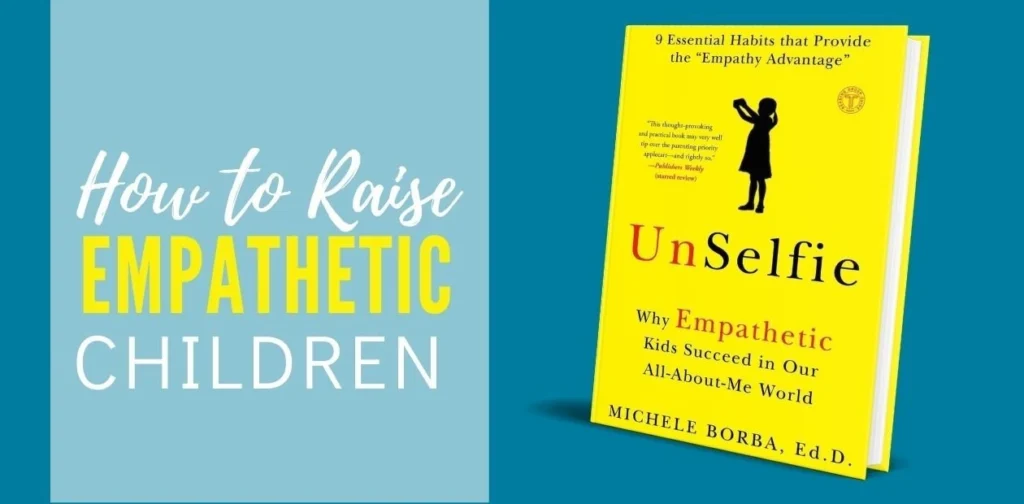
During my deep dive, I stumbled upon the work of Dr. Michele Borba, an educational psychologist and author, and it was a complete game-changer. Her book, UnSelfie: Why Empathetic Kids Succeed in Our All-About-Me World, is a goldmine for parents.
Dr. Borba’s core message is powerful: Empathy is a skill that can be taught and developed. It’s not a fixed trait you’re either born with or not.
She argues that in our hyper-competitive, selfie-driven world, we’ve accidentally pushed empathy to the side. We focus so much on grades and achievements that we forget to intentionally cultivate character. Her work provides a clear roadmap for bringing it back to the center of our parenting.
Instead of just telling kids to “share” or “be kind,” Dr. Borba breaks empathy down into actionable habits. Three of her key pillars that resonated most with me were:
- Emotional Literacy: Kids can’t empathize with feelings they can’t name. The first step is helping them build a rich vocabulary for emotions, in themselves and others.
- Perspective Taking: This is the cognitive side of empathy. It involves actively encouraging our children to wonder about what others are thinking and feeling.
- Moral Imagination: Dr. Borba explains this as the ability to feel with characters in stories, movies, and books. Immersing kids in well-told narratives is one of the safest and most effective ways to stretch their empathy muscles.
Seeing empathy framed this way, as a set of buildable skills, made the whole endeavor feel so much more possible. It wasn’t some magical quality I had to bestow; it was something we could practice together.
5 Practical Ways to Nurture Empathy in Your Everyday Life
So, how do we take this expert advice and apply it between school drop-offs and bedtime stories? Here are five simple, powerful strategies you can weave into your family’s routine.
1. Model the Empathy You Want to See
Our children are always watching. More than anything we say, they learn from what we do. The most effective way to teach empathy is to be an empathetic person yourself.
- How it looks in real life: When your partner comes home stressed from work, say out loud, “You look like you had a tough day. I’m sorry, that sounds really frustrating.” When a friend calls with bad news, let your child see you listen patiently and offer comfort.
- Talk about your own feelings: You don’t have to have it all together. Say things like, “I’m feeling a little sad today because I miss Grandma,” or “I’m so happy right now being here with you.” This shows them that all feelings are normal and okay to talk about.
2. Talk About Feelings (All of Them)
Building Dr. Borba’s “Emotional Literacy” starts with giving feelings names. Our homes should be places where emotions, from giddy joy to deep frustration, are welcomed and discussed.
- Be a feeling detective: When you read a book, pause and ask, “How do you think that character is feeling right now? Look at their face.” When you see someone on the street looking sad, you might quietly wonder together, “I wonder what’s making them feel that way.”
- Validate, don’t dismiss: When your child is upset, even over something that seems silly to you, resist the urge to say, “Don’t cry” or “It’s not a big deal.” Instead, validate the emotion. Try: “You are so angry that we have to leave the park. I get it. It’s hard to stop when you’re having fun.” This teaches them that their feelings are real and important. This is a crucial part of their social-emotional growth, one of the five key areas of child development.
3. Use Stories and Play to Widen Their World
Stories are empathy gyms. Whether it’s a book, a movie, or a made-up bedtime tale, narratives invite children to step into someone else’s life for a little while.
- Pick diverse books: Seek out stories that feature characters from different backgrounds, cultures, and family structures. This helps your child understand that while our lives might look different, many of our core feelings are the same. Discussing how culture shapes their worldview can be a powerful conversation as they get older.
- Role-play scenarios: Play is a child’s work. Use dolls, action figures, or just yourselves to act out situations. “What if Lion was sad because no one would play with him? What could Teddy do to help?” There are many fun games that can help develop these perspective-taking skills in a lighthearted way.
4. Encourage “Feeling With” Instead of “Fixing It”
As parents, our instinct is to solve our child’s problems. But when it comes to feelings, the goal isn’t always to fix them; it’s to connect with them.
- The power of a simple question: When your child tells you a friend was sad at school, your first question could be, “Oh wow, how did that feel for you to see your friend so sad?” This shifts the focus from problem-solving to shared emotion.
- Resist the silver lining: If they’re disappointed they lost the game, let them be disappointed for a bit. Before jumping to, “But you tried your best!” try sitting with them and saying, “Losing feels yucky, doesn’t it?” The connection comes from sharing the feeling, not erasing it.

5. Create Opportunities for Kindness
Empathy moves us to action. Give your child regular, age-appropriate opportunities to practice compassion. This makes it a concrete part of their life, not just an idea.
- Start small and local: This doesn’t have to be a grand gesture. It can be as simple as making a get-well card for a sick neighbor, helping carry groceries for an elderly person, or letting them pick out a can of food to donate at the supermarket.
- Care for living things: Caring for a pet or even a small plant can be a wonderful, tangible way to teach empathy. Feeding the cat, watering the basil… these small acts teach responsibility and awareness of another being’s needs.
Remember to notice their efforts. A simple, “That was so kind of you to share your drawing with your sister. Look how happy it made her,” reinforces the positive impact of their empathetic actions.
Common Questions About Teaching Empathy
At what age can kids start learning empathy?
The building blocks of empathy start forming in infancy! A baby crying when they hear another baby cry is a primitive form of affective empathy. Conscious, perspective-taking empathy starts to emerge more around ages 3 to 5 and develops throughout childhood and adolescence. The key is tailoring your approach to the different stages of their development.
Is there a difference between empathy and sympathy?
Yes, and it’s an important one. Sympathy is feeling for someone (“I feel sorry for you”). Empathy is feeling with someone (“I feel your pain”). Brené Brown, a researcher famous for her work on this, says empathy is a choice to connect with the emotion in someone else. It fuels connection; sympathy can sometimes create distance.
What if my child doesn’t seem to be getting it?
First, take a deep breath. All children develop at their own pace. A seemingly selfish phase is a normal part of development as they learn to differentiate themselves from others. Be patient and consistent. Keep modeling the behavior, talking about feelings, and creating opportunities for kindness without pressure. This is a marathon, not a sprint.
Can too much empathy be a bad thing?
This is a thoughtful question. When a person feels others’ emotions so deeply that they become overwhelmed or unable to function, it’s sometimes called “empathy distress.” Part of raising an empathetic child is also teaching them healthy emotional boundaries, like knowing it’s not their job to fix everyone’s problems and that it’s okay to take space to care for their own feelings.
The Greatest Gift You Can Give
Raising an empathetic child in a world that often seems to reward self-interest can feel like swimming against the current. But it is one of the most profound and lasting gifts you can give your child and the world they will inherit.
This isn’t about being a perfect parent who never gets frustrated. It’s about being an intentional one. It’s about seeing the meltdown over the broken cookie not just as a tantrum, but as an opportunity to say, “You’re so disappointed. I understand.” It’s about choosing a book that opens a window to another world. It’s about apologizing to your child when you make a mistake, modeling the very humility and connection you hope for them.
By nurturing empathy, you aren’t just raising a “nice” kid. You’re raising a future leader, a loyal friend, a caring partner, and a person who understands that our shared humanity is what matters most. And that is a truly incredible thing.




- Be Respectful
- Stay Relevant
- Stay Positive
- True Feedback
- Encourage Discussion
- Avoid Spamming
- No Fake News
- Don't Copy-Paste
- No Personal Attacks
- Be Respectful
- Stay Relevant
- Stay Positive
- True Feedback
- Encourage Discussion
- Avoid Spamming
- No Fake News
- Don't Copy-Paste
- No Personal Attacks
