Is My Toddler a “Late Talker”? A Reassuring Guide for Worried Parents
Published: 8 Nov 2025
You’re at the park, or maybe just scrolling through social media, and you see it. A toddler, about the same age as yours, chattering away in little sentences. And in that moment, a quiet little worry starts to creep into your mind.
Your own sweet, bright, wonderful child is… well, quieter. They might point, grunt, and pull you by the hand to show you what they want, but the words just aren’t flowing yet.
Does this sound familiar? If it does, please know you are in very good company. So many parents have felt that same knot of concern. Is this normal? Are they behind? Is my toddler a “late talker”?
I get it. Navigating these early years can feel like trying to follow a map with half the roads missing. That’s why we’re going to walk through this together. This isn’t about creating more anxiety. It’s about understanding what’s going on, learning some wonderful ways to help, and knowing when it might be time to call in a little extra support.

First, What Does “Late Talker” Actually Mean?
Before we go any further, let’s demystify this term. In the world of child development, a “late talker” isn’t a scary diagnosis. It’s a descriptive term for a toddler between 18 and 30 months old who has a good understanding of language (they can follow your directions and seem to know what you’re saying) but has a limited spoken vocabulary for their age.
Here are the general, informal guidelines speech experts often use:
- By 18 months: Typically using fewer than 20 words.
- By 24 months (2 years): Typically using fewer than 50 words and not yet combining words into simple two-word phrases (like “more milk” or “daddy go”).
The most important part of that definition is “has a good understanding of language.” This is often called receptive language. If your toddler can point to their nose when you ask, or go get their shoes from the other room, those are fantastic signs that they are processing and understanding language, even if they aren’t producing a lot of it themselves yet.
It’s also helpful to see this in the context of the five main areas of child development. Language is just one piece of an amazing, complex puzzle that makes up your child.
Signs vs. Red Flags: A Gentle Checklist
It’s easy to fall down a rabbit hole of online checklists. Let’s try to keep this simple and helpful. Think of this less as a test and more as a set of observations.
Common Signs of a Late Talker (The “Okay, let’s pay attention” signs):
- Your 18-month-old isn’t using words like “mama,” “dada,” or other simple nouns yet.
- Your 2-year-old has a vocabulary of less than 50 words.
- Your 2-year-old isn’t starting to link two words together.
- They rely heavily on gestures and sounds to communicate their needs, rather than attempting words.
Potential Red Flags (The “Maybe it’s time to chat with a professional” signs):
- Lack of understanding: Your child doesn’t seem to respond to their name by 12 months or can’t follow simple, one-step directions by 18 months (“give me the ball”).
- No gesturing: By 12-15 months, they aren’t pointing, waving “bye-bye,” or shaking their head. Gestures are a powerful precursor to verbal communication.
- Regression: Your child had some words but has lost them.
- Lack of social connection: They rarely try to get your attention or share enjoyment with you by making eye contact or sounds.
- You just have a gut feeling: Parents’ intuition is powerful. If you feel deep down that something is off, it is always worth exploring.
Many children who are late to talk are what experts call “late bloomers.” They do catch up to their peers by the time they start school. But some don’t, and early support can make a world of difference. So, how can you be that support?
How You Can Help at Home: Advice from a Leading Expert
When I started researching this for my own peace of mind, I kept coming across one name again and again: The Hanen Centre. They are a Canadian not-for-profit and a world leader in language development for young children. Their whole philosophy is that parents are their child’s most important language teachers. I love that. It feels so empowering, doesn’t it?
Their strategies aren’t about flashcards or drills. They are about turning everyday interactions into rich, language-learning opportunities. Here are a few of their simple, brilliant ideas you can start using right now.
1. Get Face-to-Face and Ditch the Questions
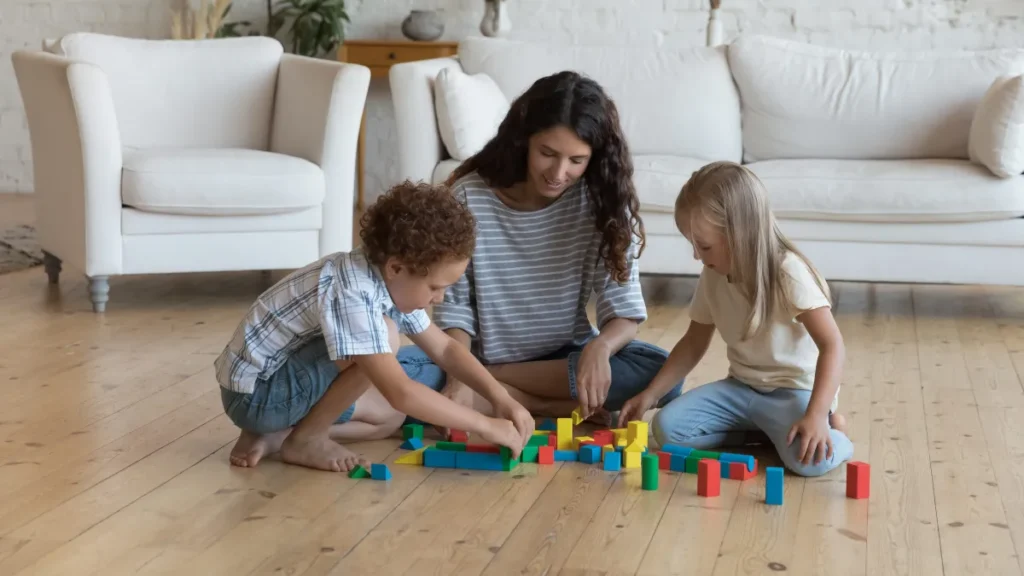
Get down on the floor, at your child’s level. When you are eye-to-eye, you can see what they are looking at and they can see how your mouth moves to make sounds.
Then, try to comment more and question less. Instead of “What’s that? Is that a car? What color is it?” which can feel like a quiz, try observing and commenting. “You have a car! Vroom, vroom. The car is going fast!” This takes the pressure off and models language in a natural way.
2. Master the “OWL” Method
This is a cornerstone of the Hanen approach. It stands for Observe, Wait, and Listen.
- Observe: Before you jump in, just watch your child. What are they looking at? What are they doing with their hands? What are they interested in at this exact moment? That’s your starting point.
- Wait: This is the hardest part! After you say something, count to five in your head. Give your child time and space to process what you said and form a response. It might be a sound, a look, a gesture, or even a word. We often rush to fill the silence, but magic happens in that pause.
- Listen: Listen with your ears and your eyes. A grunt and a point toward the juice is a communication! Acknowledge it. “Oh, you want juice! You’re telling me you’re thirsty. Let’s get some juice.”
3. Use the “Four S’s”
Once you know what your child is interested in, you can use these simple techniques to make your language easier for them to learn.
- Say Less: Instead of “Look, we’re going to put on your big red boots now because it’s raining outside,” try “Boots on.” Use short, simple phrases that are easier for them to remember and repeat.
- Stress: Emphasize important words with your voice. “It’s a big BALL!” or “Time to go UP the stairs.” This makes the key word pop.
- Go Slow: Stretch out important words. Talk a little more slowly than you normally would. This gives their developing brain more time to process the sounds. Think “baaaaaall” instead of a quick “ball.”
- Show: This is the most intuitive one. Point to what you’re talking about. Use gestures. Hold up the object. Show them what you mean.
Using these strategies doesn’t just encourage talking; it builds connection. It shows your child that you see them, you hear them, and you are interested in their world. It’s also one of the most fundamental ways we how to teach empathy.
When to Talk to Your Pediatrician or a Speech Therapist
If you’ve tried these strategies for a few months and you’re still concerned, or if you noticed any of the “red flags” from earlier, it is a great idea to seek a professional opinion. There is zero harm in getting an evaluation, but there is immense benefit to starting early intervention if it’s needed.
Here’s the process:
- Talk to your pediatrician: They can conduct a developmental screening and rule out other issues, like hearing problems. An ear infection with fluid can make it hard for a child to hear sounds clearly, affecting their speech.
- Ask for a referral: Your doctor can refer you to a Speech-Language Pathologist (SLP). An SLP is a trained expert in all things communication.
- Get an evaluation: An SLP will play with your child to assess both their receptive and expressive language skills. It’s not a scary test! It’s designed to be fun and get an accurate picture of your child’s abilities.

An evaluation can give you one of two wonderful things: peace of mind that your child is on the right track, or a clear plan to help them thrive. Both are wins.
Common Questions Parents Ask
Let’s tackle a few of the big questions that often come up.
Is it true boys talk later than girls?
There is some data showing that, on average, girls tend to develop language skills slightly earlier than boys. However, the range of “normal” is huge for both genders. A significant delay is a concern for any child, regardless of whether they are a boy or a girl.
My toddler understands everything I say. Should I still be worried?
This is a fantastic sign! Strong receptive language is the foundation for spoken language. Many late talkers with excellent comprehension do catch up on their own. Continue using the strategies above to bridge the gap between their understanding and their speaking.
Does screen time cause speech delays?
This is a hot topic. The American Academy of Pediatrics recommends very limited screen time for toddlers precisely because language is learned through back-and-forth human interaction. A screen can’t OWL (Observe, Wait, Listen) or respond to your child’s specific cues. While screen time may not directly “cause” a delay, it does take away from the valuable, interactive time that is proven to build language.
What are some good non-toy activities to encourage speech?
Simple daily routines are goldmines! Talk your way through bath time (“wash your TUMMY,” “more BUBBLES”), getting dressed (“SOCKS on”), or preparing a snack. Reading books and singing songs are also incredibly powerful and great games that boost a toddler’s cognitive development.
You Are Your Child’s Biggest Champion
The journey of language is a marathon, not a sprint. Every child follows their own unique timeline, and seeing the bigger picture of their development is so important.
The fact that you are here, reading this, already shows what an amazing and dedicated parent you are. Your concern comes from a place of deep love. By getting down on the floor, observing what fascinates them, and playfully interacting with them, you are giving your child the richest, most effective language lesson in the world.
Stay patient, stay playful, and celebrate every little effort, from a grunt to a gesture to a brand new word. You are their safe space to learn and grow. You’ve got this.

How to Teach Empathy: A Real-Life Guide for Raising Kind, Emotionally Intelligent Kids





- Be Respectful
- Stay Relevant
- Stay Positive
- True Feedback
- Encourage Discussion
- Avoid Spamming
- No Fake News
- Don't Copy-Paste
- No Personal Attacks
- Be Respectful
- Stay Relevant
- Stay Positive
- True Feedback
- Encourage Discussion
- Avoid Spamming
- No Fake News
- Don't Copy-Paste
- No Personal Attacks
