Your Guide to Social Development Milestones: From First Waves to First Friendships (Ages 1-5)
Published: 19 Nov 2025
You’re at the park, watching your two-year-old. He’s happily engrossed in pouring sand from one bucket to another, completely ignoring a little girl who is trying to hand him a flower. Your mind starts to spin. Should he be playing with her? Is he supposed to be making friends by now?
If you’ve ever felt that jolt of comparison or a flicker of worry about your child’s social growth, please know you are not alone. In a world of playdates and preschool comparisons, it’s easy to get caught up in wondering if your child is hitting their social development milestones.
But let’s take a deep breath together. This guide isn’t a report card for your child or a reason to worry. Think of it as a friendly, reassuring roadmap. We’ll walk through the beautiful, messy, and incredible journey of how your child learns to connect with the world, one tiny interaction at a time. We’ll cover the typical path from ages one to five, how you can support them, and what to do if you still have concerns.
First, What Exactly Is Social Development?
Before we jump into the timelines, let’s get on the same page. Social development is simply the process of learning the values, knowledge, and skills that allow a child to relate to others effectively.
It’s about moving from a world that revolves entirely around them to understanding that other people have thoughts and feelings, too. It’s learning to share (a truly monumental task!), take turns, listen, and cooperate. These are some of the most complex skills a human being ever learns, and the foundation is laid in these precious early years. It’s one of the 5 main areas of child development that all work together to help your child grow.
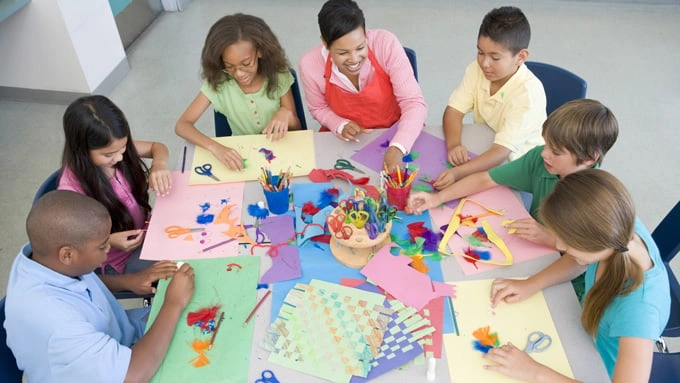
The Journey of Social Growth: Milestones by Age
Remember, every child travels at their own pace. These age brackets are general guides, not rigid deadlines. A child’s temperament, environment, and even their mood on a given day can affect how they interact.
Ages 1-2: The Budding Explorer
This is the age of “me.” Your little one is the center of their universe, and that’s exactly where they need to be. They are just starting to realize they are a separate person from you. Social interaction is often about getting a need met or exploring what another person does.
What you might see:
- Handing you a toy or book to get you to play.
- Waving “bye-bye” and showing a preference for familiar people.
- Starting to say “no” and showing a strong sense of independence.
- Engaging in parallel play: playing alongside another child, but not necessarily with them. They might be in the same sandbox, but they are in their own little worlds.
- Imitating your actions, like pretending to talk on the phone or sweep the floor.
How you can help:
Be their safe base. A strong, loving bond is the very foundation of healthy social skills. This is the core of a secure attachment. Respond to their bids for connection, even when it’s the 100th time they’ve handed you that same block. Narrate the world around them, including social interactions: “Look, Noah is sharing his truck with his mommy. That’s so kind.”
Ages 2-3: The World of “Mine!”
Ah, the infamous toddler years. If you’re hearing “Mine!” on a loop, congratulations, your child’s social development is right on track. This age is marked by a powerful drive for autonomy and a dawning, but very fuzzy, understanding of others. They know other kids exist, but they don’t quite grasp the concept of them as people with separate feelings.
What you might see:
- Difficulty sharing is the hallmark of this stage. It’s not selfishness; they are just beginning to understand ownership.
- Starting to show interest in what other kids are doing.
- May have huge emotions (aka tantrums) when they don’t get their way in a social setting.
- Associative play begins to emerge. They might play with the same toys as another child and briefly interact, but there’s no coordinated goal.
- They may begin to show concern if they see someone is sad, even if they don’t know how to help.
How you can help:
Don’t force sharing. Instead, introduce the concept of “taking turns.” Use a timer to make it concrete. “You can have the blue car for two minutes, and then it will be Sarah’s turn.” This is also a great time to start teaching the basics of feelings. As you help them grow their vocabulary for emotions, you are laying the groundwork for empathy. The journey of how to teach empathy starts with these simple labels.
Ages 3-4: The Cooperative Friend
Welcome to the age of imagination and budding friendships! Your child is starting to understand that playing with others can be more fun than playing alone. Their world is expanding, and they are genuinely curious about other children.
What you might see:
- Cooperative play starts to blossom. Children will work together toward a common goal, like building a tower or playing “house.”
- They start to form real, if temporary, friendships and may have a “best friend.”
- They can take turns in games and show more understanding of rules.
sharing becomes a little easier (though still not perfect!). - They can show more obvious empathy, like offering a hug or a toy to a crying friend.
How you can help:
Facilitate playdates, but keep them short and sweet. One-on-one is often easier to manage than a large group. Provide props for pretend play: old clothes for dress-up, boxes to build a fort, or a play kitchen. This type of play is a social skills powerhouse. It’s where they practice negotiation (“I’ll be the mommy, you be the baby”), problem-solving, and seeing things from another’s perspective.
Ages 4-5: The Little Leader & Empath
Your preschooler is becoming a truly social being. They understand social rules (mostly!), enjoy playing with friends, and have a much richer emotional life. They can tell stories, crack jokes, and are starting to become the kind of person you’d actually want to have a conversation with.
What you might see:
- Enjoys more complex, imaginative games with detailed rules and roles.
- Wants to please friends and be liked. They may be more sensitive to rejection.
- Can better understand the concept of fairness.
- They can express their own emotions and are better at recognizing them in others.
- They might start telling “secrets” and have a clear group of friends.
How you can help:
Talk through social conflicts. Instead of just solving the problem for them, ask questions: “It sounds like you were really angry when Leo took the red crayon. What could we do next time?” This builds problem-solving skills. Read books that feature friendships, conflicts, and emotions. Talk about the characters and what they might be feeling.
Our Expert Guide: Understanding Erik Erikson’s Vision
It can be helpful to see the “why” behind these stages. The renowned developmental psychologist Erik Erikson gave us a powerful framework for this. He didn’t just create a list of milestones; he described the core emotional “jobs” of childhood. He called them the Stages of Psychosocial Development.
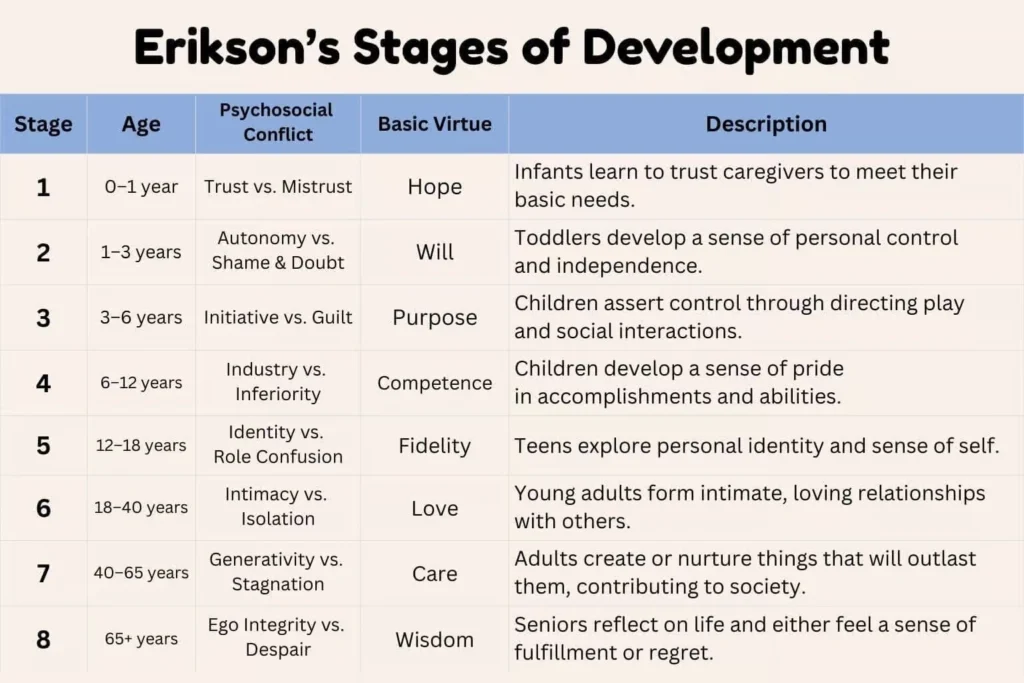
For our kids aged 1-5, two of his stages are incredibly relevant:
- Autonomy vs. Shame and Doubt (Ages 1-3): This is the “I do it myself!” stage. Erikson explained that toddlers have a deep, biological need to assert their independence. When we let them try things on their own (like putting on their own shoes, even if it takes forever), we build their sense of autonomy. When they are constantly criticized or controlled, they can develop a sense of shame and doubt their own abilities. This is why that struggle over “Mine!” is so important. They are fighting for a sense of self.
- Initiative vs. Guilt (Ages 3-5): As preschoolers, children want to do things. They want to plan games, make up stories, and “help” you cook. This is their initiative. Erikson taught that when we encourage this drive, they develop confidence and a sense of purpose. If their attempts are shut down or seen as a nuisance, they can develop a sense of guilt, feeling that their ideas are “bad.”
Seeing it this way helps us reframe our role. We aren’t just managing behavior; we are nurturing the very core of their future confidence and social competence.
What If My Child Seems “Behind”?
This is the question that keeps many parents up at night. First, it is so important to remember the vast spectrum of “normal.” Shyness is not a developmental delay. A preference for quiet play is not a red flag. Children, like adults, have different personalities.
However, if you have a persistent gut feeling that something isn’t clicking, it’s always okay to seek support. You are the expert on your child.
Consider talking to your pediatrician or a child development specialist if you notice a consistent pattern of:
- Not responding to their name by 12-15 months.
- Avoiding eye contact or not showing interest in others.
- A lack of interest in games like peekaboo or imitation.
- Not pointing to show you things of interest.
- Significant language delays, which can sometimes impact social skills. If this is a concern, check out these strategies for a potential “late talker”.
- A strong, ongoing preference for playing alone and a lack of interest in peers, even by age 4 or 5.
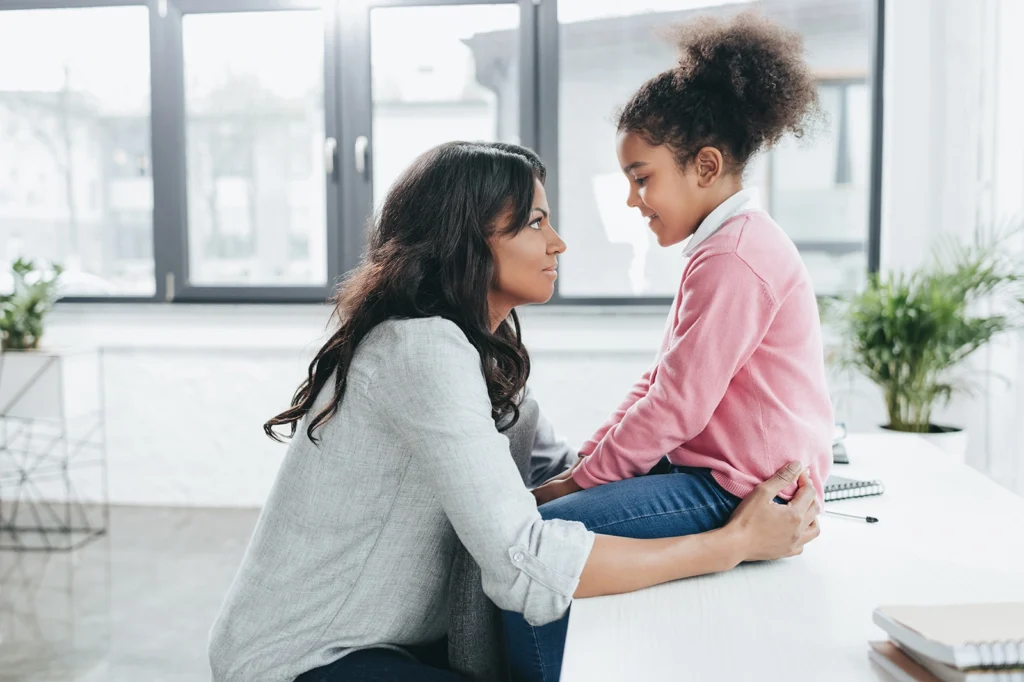
Raising these concerns can feel stressful. It’s okay to feel that way. It’s a good time to use some simple tips to manage anxiety and stress, because your well-being matters immensely. Speaking with a professional isn’t about getting a label; it’s about getting clarity and support for you and your child.
Common Questions About Social Milestones
How do I handle the constant battles over sharing?
Try “toy trading.” Instead of “Give that back,” try “If you want the truck Maya is using, you need to offer her another toy to trade.” It empowers both children and teaches negotiation. For treasured items, it’s okay to put them away before a friend comes over.
Is it okay if my child is shy?
Absolutely. Shyness is a personality trait, not a flaw. A shy child might be a fantastic observer, learning a lot by watching from the sidelines. Don’t push them into the fray. Instead, be their safe person. Sit with them, observe together, and let them join in when they feel ready.
How can I help my child make friends?
Start by being a good model. Let them see you interact positively with your own friends. Narrate social situations you see in public or in books. And remember, for a young child, you are their first and most important friend. Your playful, connected relationship is the best “friendship school” there is. If you’ve been feeling disconnected and maybe even yelled at your kids more than you’d like, focusing on repair and reconnection is the most powerful first step.
The journey of watching your child unfurl into a social being is one of the most rewarding parts of parenting. It won’t always be smooth, and there will be plenty of messy, awkward, and frustrating moments along the way.
But it’s not about perfection. It’s about connection. Every time you get down on the floor to play, comfort a big feeling, or narrate the world around them, you are giving them the building blocks they need. So, watch them, enjoy them, and trust the process. You’re doing a great job.





- Be Respectful
- Stay Relevant
- Stay Positive
- True Feedback
- Encourage Discussion
- Avoid Spamming
- No Fake News
- Don't Copy-Paste
- No Personal Attacks
- Be Respectful
- Stay Relevant
- Stay Positive
- True Feedback
- Encourage Discussion
- Avoid Spamming
- No Fake News
- Don't Copy-Paste
- No Personal Attacks
