The Science of Connection: How Oxytocin Shapes the Parent-Child Bond
Published: 19 Nov 2025
The “Love Hormone” Explained: How Oxytocin Actually Shapes Your Bond
There is a specific moment many parents know well. It happens when you are rocking your baby in the quiet of the night, or when your toddler suddenly stops running around to wrap their arms around your leg. In that split second, your shoulders drop. The noise of the world fades. You feel a warm, settling peace wash over you.
We often call this “love.” Scientists call it a chemical reaction.
While it might feel unromantic to reduce that overwhelming rush of affection to a molecule, understanding the science behind it is actually incredibly empowering. It proves that your instincts to hold, rock, and comfort your child are not just “nice to have.” They are biologically essential.
I’ve spent some time digging into the research on this, specifically focusing on oxytocin (often called the “love hormone”). What I found changed the way I view those everyday moments of connection. It turns out that every time you engage with your child, you are literally shaping the architecture of their brain.
Let’s break down what is happening beneath the surface and, more importantly, how we can use this knowledge to be better, calmer parents.
What Is Oxytocin, Really?
At its simplest level, oxytocin is a neuropeptide produced in the hypothalamus of the brain. While it is famous for its role in childbirth and breastfeeding, its job description is much broader.
Think of oxytocin as the biological “glue” of social relationships.
When oxytocin is released into your bloodstream and your brain, it lowers your heart rate. It reduces blood pressure. It dials down the stress hormone cortisol. For a child, whose brain is developing at a rapid pace, this chemical cocktail provides the feeling of safety required for them to explore the world.
But here is the most fascinating part: it is a two-way street.
The Expert View: It’s About “Synchrony”
This is where we need to look at the work of Dr. Ruth Feldman, the Director of the Center for Developmental Social Neuroscience. She has spent decades studying the biology of human connection.
Dr. Feldman introduced a concept called “Bio-Behavioral Synchrony.”
This might sound like a mouthful, but the concept is beautiful. Her research suggests that the parent-child bond isn’t just about the parent giving love to the child. It is a coordinated dance.
When you interact with your child lovingly (through eye contact, touch, or vocal soothing), your oxytocin levels rise. Dr. Feldman’s studies show that when this happens, your child’s oxytocin levels rise to match yours. Your heart rhythms even begin to synchronize.
You are not just two separate people hanging out; physiologically, you become a single unit.
This “synchrony” helps the child learn self-regulation. Because their brain is immature, they cannot calm themselves down from big emotions yet. They literally borrow your calm nervous system to regulate their own.
Have you ever noticed how hard it is to calm a crying child when you are feeling panicked yourself? That is the lack of synchrony. Your stress signals are interfering with the transfer of calm.
Practical Ways to Boost the “Oxytocin Loop”
You do not need to be a scientist to trigger this release. You just need to be present. Here are three evidence-based ways to get the oxytocin flowing for both you and your child.
1. The Power of Physical Touch
Touch is the most potent trigger for oxytocin. This includes skin-to-skin contact for newborns, but it applies to older kids too. Rough-and-tumble play, back rubs, or a long hug (research suggests 20 seconds is the sweet spot) all flood the brain with this connection hormone.
2. The “Gaze” Factor
Dr. Feldman’s research highlights the importance of the “social gaze.” When you look into your child’s eyes with warmth, it signals safety. In our distracted world, we often look at our kids while glancing at our phones. Try putting the phone down and holding eye contact for a few moments when they are talking to you. The biological payoff is immense.
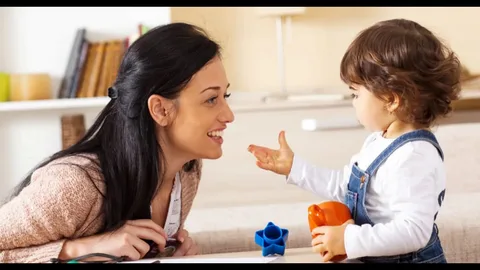
3. Playfulness and Laughter
Laughter is a massive oxytocin booster. If you are looking for ways to get started, check out these 10 fun games that boost a toddler’s cognitive development. Play isn’t just a distraction; it is a biological bonding event.
The Antagonist: Stress and Cortisol
We cannot talk about oxytocin without talking about its nemesis: Cortisol.
Dr. Sue Carter, a biologist at the Kinsey Institute and a pioneer in this field, explains that oxytocin and stress hormones have a complex relationship. While oxytocin can help reduce stress, high levels of chronic stress can inhibit the release of oxytocin.
This is why parenting feels so much harder when you are burnt out. It is not just in your head; it is a chemical blockade.
If you are in a state of high anxiety or “fight or flight,” your body prioritizes survival over connection. You might find yourself snapping at your kids or feeling “touched out.” This is a signal that your cortisol is too high.

This is why self-care is not selfish. If you feel like you are running on empty, you might want to read about how to reduce parental burnout and finally feel like yourself again. You have to lower your own stress baseline to let the oxytocin flow again.
Why This Matters for the Long Term
You might be asking yourself: “Does this really matter if I miss a few hugs?”
The occasional bad day is normal. We are human. But the pattern of connection matters. The oxytocin system is responsible for developing empathy and social skills later in life.
When a child experiences repeated “synchrony” with a parent, their brain builds a blueprint for what relationships look like. They learn to trust. They learn how to read social cues. [Internal Link Opportunity 3] This foundation is exactly what is secure attachment, and it sets the stage for their future friendships and romantic partnerships.
Common Questions About Oxytocin and Bonding
I didn’t breastfeed. Did I miss out on the oxytocin bond?
Absolutely not. While breastfeeding releases oxytocin, it is certainly not the only way. Bottle-feeding parents who use eye contact, skin-to-skin touch, and warm vocals generate the exact same “synchrony” Dr. Feldman describes. Connection is about interaction, not just nutrition
I had a traumatic birth or C-section. Is my bond ruined?
No. The brain is incredibly plastic (changeable). While birth is a high-oxytocin event, the thousands of interactions you have in the weeks, months, and years following birth are what solidify the bond. It is never too late to build synchrony
Does yelling destroy oxytocin?
Chronic yelling can create a stress response that blocks connection, yes. But repair is powerful. [Internal Link Opportunity 4] If you’ve had a bad moment, learning how to repair & reconnect after yelling at your kids can actually strengthen the bond because it teaches the child that the relationship is resilient
The “Good Enough” Parent
It is easy to read about brain science and feel pressure to be perfect. Please don’t fall into that trap.
The goal isn’t 100% synchrony all the time. That is impossible. Dr. Ed Tronick, another key researcher, found that even the best parents are only “in sync” with their children about 30% of the time. The rest of the time is spent out of sync or repairing the connection.

Your child does not need a parent who is flooded with oxytocin 24/7. They need a parent who tries. A parent who puts down the phone to look them in the eye. A parent who offers a hug after a tantrum.
So, the next time you sit down to read a book with your child or soothe them after a fall, remember: You aren’t just comforting them. You are using the science of connection to build a brain that knows how to love.






- Be Respectful
- Stay Relevant
- Stay Positive
- True Feedback
- Encourage Discussion
- Avoid Spamming
- No Fake News
- Don't Copy-Paste
- No Personal Attacks
- Be Respectful
- Stay Relevant
- Stay Positive
- True Feedback
- Encourage Discussion
- Avoid Spamming
- No Fake News
- Don't Copy-Paste
- No Personal Attacks
